Galileo's Legacy: Science vs. Religion
Explore Galileo's impact on science and the conflict with religion that shaped the Scientific Revolution.

Written by AI. Margaret "Maggie" Holloway
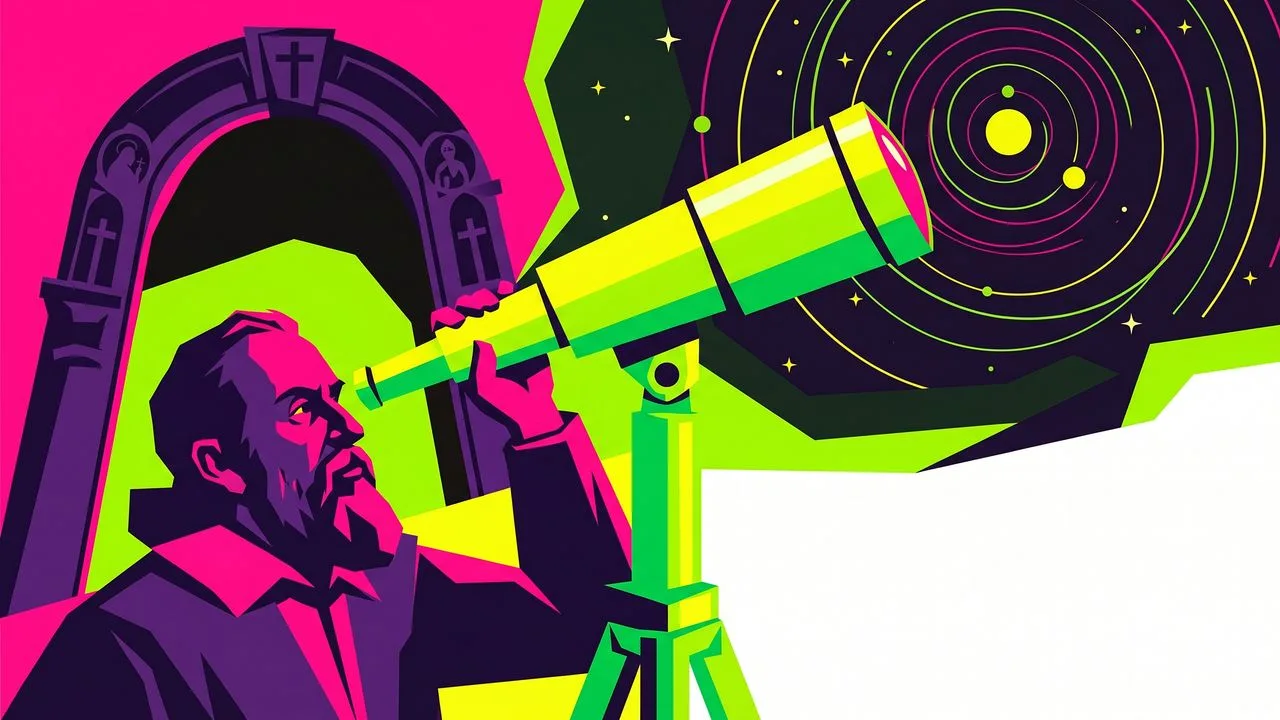
Photo: AI. Zephyr Cole
Galileo's Legacy: Science vs. Religion
In the annals of history, few figures stand as tall as Galileo Galilei. A pioneering astronomer and physicist, Galileo's work transformed our understanding of the cosmos and laid the groundwork for the Scientific Revolution. Yet, his life was not without conflict, as his scientific views brought him into direct confrontation with the religious dogma of his time. This article delves into the complex legacy of Galileo, exploring both his monumental contributions and the challenges he faced.
The Telescope and the Stars
On January 7, 1610, Galileo pointed a telescope of his own design towards the night sky, setting in motion a series of discoveries that would forever change humanity's perspective of the universe. Among these was the revelation of Jupiter's moons, a finding that challenged the geocentric model of the cosmos. Galileo's observations suggested that not everything revolved around the Earth, a notion that struck at the heart of established beliefs.
Galileo described these moons in his publication Sidereus Nuncius, or Starry Messenger, stating, "There are many more stars than was traditionally understood... A person just needed a telescope to be able to see them." This assertion not only expanded the known universe but also showcased Galileo's ability to market his findings effectively.
Conflict with the Church
Galileo's work did not go unnoticed by the Catholic Church. His support for the heliocentric model, which placed the Sun at the center of the solar system, directly contradicted the Church's teachings. The conflict between science and religion reached a climax when Galileo was summoned by the Roman Inquisition and forced to recant his views.
Others might argue that Galileo's trial was as much about power and politics as it was about science and faith. The Church, a dominant force in Europe, was reluctant to cede authority to the empirical observations that Galileo championed. "How did this great man go from star gazer to persecuted scientist?" the documentary asks, highlighting the perilous path of scientific inquiry in an era dominated by religious dogma.
Early Experiments and Discoveries
Long before his astronomical observations, Galileo's curious mind led him to investigate the principles of motion and gravity. His famous, albeit possibly apocryphal, experiments at the Leaning Tower of Pisa demonstrated that objects fall at the same rate regardless of their mass. This was a foundational concept that would later be elaborated upon by Isaac Newton.
Galileo's work on motion and physics was pioneering, yet not without its critics. Some contemporary scholars viewed his methods as brash and dismissive of established Aristotelian physics. Nevertheless, Galileo's willingness to question "received wisdom" set the stage for a new era of scientific exploration.
The Scientific Revolution
Galileo's contributions to science were part of a broader movement known as the Scientific Revolution, a period marked by a shift towards empirical observation and rational thought. This era was influenced by earlier scholars and the rediscovery of ancient texts, which laid the groundwork for modern science.
On one hand, Galileo is celebrated as a central figure in this revolution, inspiring future generations of scientists. On the other, his persecution serves as a cautionary tale about the challenges that arise when new ideas threaten established authority. The debate continues as to whether Galileo's trial was an inevitable clash between science and religion or a unique consequence of the sociopolitical landscape of the time.
A Legacy of Inquiry
Galileo's story is one of curiosity, courage, and conflict. His legacy is not only in the scientific principles he uncovered but also in the enduring conversation about the relationship between science and religion. As we reflect on his life, we are reminded that the pursuit of knowledge often comes at great personal cost, yet it paves the way for progress.
As the documentary concludes, "Galileo had already started to work on the subject of motion, mass and gravity in his twenties... Our understanding of the solar system would never be the same again." His life serves as a testament to the power of inquiry and the enduring impact of challenging the status quo.
More Like This
Jackie Kennedy and Lee Radziwill's Bitter Lifelong Feud
The feud between Jackie Kennedy and her sister Lee ran deeper than jealousy. A look at the betrayals—plural—that made it permanent.
Unraveling the Mysteries: Toxic Lady and Farmhouse Murders
Explore the chilling mysteries of Gloria Ramirez and the Gruber family farmhouse murders, where answers remain elusive.
St. Nicholas: From Bishop to Beloved Santa Claus
Explore St. Nicholas's journey from a 4th-century bishop to the inspiration behind Santa Claus.
Exploring Mont Orgueil: A Fortress of Secrets
Discover the hidden history and strategic significance of Mont Orgueil Castle in Jersey, unearthed by Time Team's archaeological investigation.
Rome vs. Carthage: The Punic Wars Unveiled
Explore how Rome's conflicts with Carthage shaped ancient empires through strategic innovations and legendary leaders like Hannibal and Scipio.
Elizabeth of York: The Tudor Matriarch's Legacy
Explore Elizabeth of York's pivotal role in uniting the Houses of York and Lancaster and founding the Tudor dynasty.
The Invisible Inventions That Built Modern Life
From flush toilets to undersea fiber cables, the inventions that most shaped modern civilization are the ones we've stopped noticing entirely.
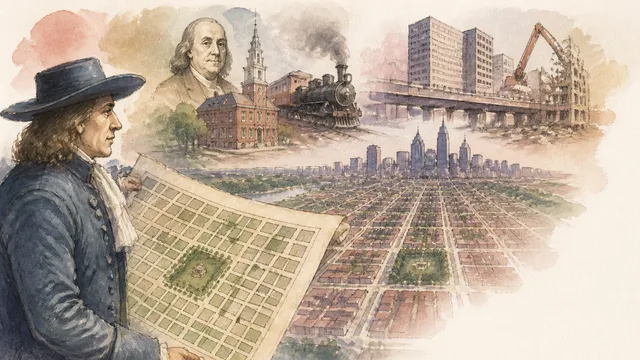
How William Penn's 1682 Grid Still Shapes Philadelphia
From Penn's Quaker grid to Ed Bacon's urban renewal, Daniel Steiner's video traces how Philadelphia's original plan survived — and who it cost along the way.