The AI Skill That Expires Every Three Months
AI capabilities expand so fast that the workforce skill needed to work alongside them degrades quarterly. Here's what's replacing traditional training.

Written by AI. Rachel "Rach" Kovacs
Every workforce skill in history has had a finish line. You learned to read, you could read. You learned SQL, you knew SQL. The skill might get rusty, but the target stayed put.
AI doesn't work that way.
Nate B Jones, an AI strategy analyst, has been tracking something unusual: the most valuable professional capability right now isn't learning AI tools—it's learning to work at the constantly shifting boundary between what AI can do and what still requires a human. He calls this "frontier operations," and it's the first workforce skill that expires on a quarterly cycle.
The metaphor he uses is a bubble. Everything inside the bubble is what AI agents can handle reliably today. Everything outside still requires a person. The surface of that bubble—that thin membrane where you're deciding what to delegate, how to verify output, where to intervene—that's where the valuable work happens.
But here's the part most coverage misses: when that bubble expands with each model release, the surface area doesn't shrink. It grows. "There's more boundary to operate at, more places for human judgment, not less," Jones explains. "More seams between human and agent work, not less."
This creates a structural problem. We're trying to teach an expanding-surface skill using fixed-destination methods. Every curriculum, every certification program, every corporate training assumes the target stands still. This one keeps moving.
Five Skills That Degrade Quarterly
Jones breaks frontier operations into five components, each of which requires continuous recalibration:
Boundary sensing is maintaining accurate intuition about where the human-agent boundary currently sits. A product manager who learned in November that agents couldn't handle competitive analysis might not realize that by February, agents can nail the market sizing and feature comparisons—but still miss the political dynamics between executives they've never observed. The skill isn't knowing the boundary once. It's updating that knowledge with every capability jump.
The failure mode here is expensive in both directions. Over-trust burns you with hallucinations. Under-trust means you're manually doing work an agent now handles better than you do. Most commonly, people calibrated six months ago and haven't noticed the boundary moved.
Seam design structures work so transitions between human and agent phases are clean and verifiable. This is architectural thinking: if you break a project into seven phases, which three are fully agent-executable? Which two need human-in-the-loop? What artifacts pass between phases to verify the handoff worked?
The reason this differs from standard project management: the answer changes as capabilities shift. "The seam that was in the right place last quarter is in the wrong place this quarter," Jones notes. A consulting engagement manager might have required manual fact-checking on every data point three months ago. But if agent citation accuracy improved dramatically, that verification seam should move—or you're wasting human attention on checks the system no longer needs.
Failure model maintenance means tracking how agents fail now, not how they failed six months ago. Early language models failed obviously—garbled text, wrong facts, incoherent reasoning. Current frontier models fail subtly: correct-sounding analysis built on a misunderstood premise, plausible code that breaks on edge cases, research summaries that are 98% accurate with 2% confidently fabricated.
A corporate counsel might know that agents catch boilerplate contract issues but miss non-standard termination language and the interaction between liability caps in Section 7 and carveouts buried in exhibits. The failure model says: trust the boilerplate scan, manually review cross-references between liability provisions. That's a different check than "read the whole thing again"—and it takes much less time.
Capability forecasting isn't predicting the future of AI. It's making sensible 6-to-12-month bets about what's likely to become agent territory, then investing learning accordingly. Jones compares it to reading swells in the ocean: "A surfer doesn't predict exactly what the next wave will look like, but a good surfer will read the sea, understand how the floor shapes waves at this particular break, and position themselves where the next ridable wave is most likely to form."
A UX researcher watching agents improve at survey design and qualitative coding might start investing in interpretive synthesis—the skill of turning coded data into product insights that shift a roadmap. The coding is migrating inside the bubble. The "so what" of the coding is where the new surface sits.
Leverage calibration is deciding where to spend human attention when you're supervising 50 to 100 agent streams with 8 hours in a day. McKinsey and other firms are converging on roughly 10:1 agent-to-human ratios for end-to-end processes. The math is unforgiving: you cannot review everything at the same depth.
An engineering manager might let most agent-generated code flow through automated test suites, flag billing and data pipelines for human code review, and escalate only architectural decisions and cross-system changes for deep engagement. Those thresholds get recalibrated monthly as agents improve at the routine tier.
Why This Can't Be Automated Away
Most AI-adjacent skills will eventually get absorbed into the technology itself. Prompting techniques are already baking into system defaults. Integration patterns are getting productized.
But frontier operations resists automation by definition. When a task migrates inside the AI capability bubble, the surface just expands outward. The person operating at the surface moves with it. "The skill is sort of structurally resistant to its own obsolescence," Jones observes.
This creates a compounding advantage. Someone who develops these skills six months earlier than their peers doesn't just have a head start—they have six months of calibration their peers can't replicate. As capabilities accelerate, the distance between calibrated and uncalibrated workers keeps widening.
Jones argues this explains the leverage numbers appearing in production deployments. Companies like Cursor and Lovable hitting significant revenue with small teams, or Anthropic's shipping velocity—the gap isn't explained by better tools. It's explained by people who've developed the operational practice to stay on the bubble and convert those tools into reliable output as AI evolves.
The Economic Question
The models are commoditizing. Compute is being built everywhere. What remains scarce, Jones suggests, is "the human capacity to convert those inputs into economic output."
If he's right, the critical question for the next decade isn't which economies build the best models or have the most compute—both are increasingly portable or rentable. It's which economies can field workers excellent at operating at the human-AI frontier.
That's a workforce development challenge no training infrastructure is currently designed to solve. Every educational system we've built assumes you can teach someone a skill, certify their competence, and know that competence will hold for years. But when the skill itself expires quarterly, the entire model breaks.
The people and organizations figuring this out first aren't just gaining an advantage. They're developing a form of operational intelligence that compounds with every model release while everyone else's knowledge decays.
More Like This
Elementor's AI Tool Generates Custom Code in Seconds
Elementor's new Angie Code AI converts plain-language prompts into production-ready widgets and functionality. But can it deliver on the security promises?
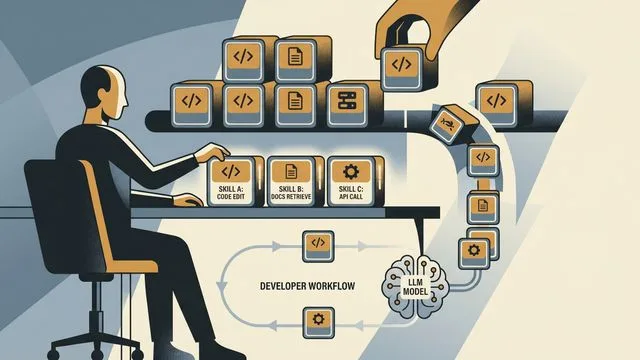
AI Skills at Scale: Teaching Agents Your Standards
Nick Nisi and Zack Proser of WorkOS make the case that structured markdown 'skills' are how you stop re-explaining yourself to AI agents every single day.
AI and High Agency: Navigating Career Disruption
Explore how AI and high agency are reshaping careers, and the unique opportunities for growth and adaptation.
One AI Agent Saved $4,200, Another Spammed 500 Texts
OpenClaw reveals what happens when 145K developers build AI agents: brilliant car negotiations, catastrophic database wipes, and everything in between.
Why Your AI Coding Tool Choice Matters More Than You Think
The AI model gets all the attention, but the harness—how it integrates into your workflow—is where the real performance difference lives.
Anthropic's Sonnet 4.6: When A 'Workhorse' Model Gets Scary Good
Claude Sonnet 4.6 blurs the line between mid-tier and flagship AI. What happens when capabilities outpace our ability to measure them?

Flock Safety Cameras: Crime Tool or Privacy Risk?
Flock Safety's license plate readers are spreading fast. Retired Microsoft engineer Dave Plummer breaks down what they actually capture—and what's at stake.

Why AI AppSec Needs Organizational Context to Work
AI finds more vulnerabilities than ever—but without organizational context, it still can't tell you which ones actually matter. Here's what that gap costs.