OpenAI's GPT-5.4 Can Now Test Its Own Code Like a Human
OpenAI's new GPT-5.4 model can interact with computers to test code, build apps, and generate websites—while cutting token usage by two-thirds.

Written by AI. Marcus Chen-Ramirez
OpenAI's latest model update does something I find both technically impressive and slightly unsettling: it can click through software interfaces to test its own code, the same way a human QA tester would.
The feature, called "persistent computer use" (or KUA in OpenAI's nomenclature), appears in GPT-5.4 Thinking, the company's newest release. According to OpenAI researcher SQ Mah, who demonstrated the capability in a brief video this week, the model can now interact with user interfaces to verify that the applications it builds actually work—without spinning up separate testing environments or requiring developers to write explicit test cases.
This represents a different approach to AI code generation than we've seen before. Most code-generating models output text and hope for the best. GPT-5.4 apparently opens the application, clicks buttons, drags chess pieces, and inspects whether reflections render correctly in a 3D environment. It's quality assurance as a native capability rather than an add-on.
What Actually Changed
The technical improvement centers on efficiency. Mah claims that "with persistent KUA, we're seeing in some cases when we ask the model to test work that the token use has actually dropped by 2/3, which is quite exciting."
That's significant if true. Tokens are the units of computation—and cost—in large language models. Every interaction, every API call, every character of input and output counts against your usage. A 66% reduction in token consumption for testing workflows would meaningfully affect the economics of using AI for software development, particularly for complex applications that require multiple rounds of testing and iteration.
The "persistent" part matters too. Previous versions apparently needed to "spin up like a new environment" each time the model wanted to test something. The new approach is "more like how you or I would interact with a computer," according to Mah. The model maintains context across interactions rather than starting fresh each time—which maps more closely to how human developers actually work.
Mah demonstrated this with a 3D chess game built in Electron. The prompt: "Build and test a 3D chess game with glass and marble effects." The model not only generated the code but then played the game itself, testing edge cases like castling—a chess move that requires understanding specific board states and multiple piece interactions simultaneously.
"This is a challenging use case for KUA because there's so many pieces," Mah explained. "You have to click the right pieces. Are like reflections working? The model needs to have a good sense of like all the rules and then how like manipulating those pieces will lead to a state where you can actually test out those rules."
Watching the model castle correctly suggests it's not just clicking randomly. It understands chess rules well enough to create board states that test specific functionality. That level of domain knowledge, applied dynamically through a UI, is genuinely novel.
The Non-Coder Use Case
The second capability Mah demonstrated feels more immediately practical for people who don't write code: image-to-website generation with contextually appropriate imagery.
The scenario: Mah's partner Nancy wants to start a coffee shop but isn't a developer. She provided a design mockup. GPT-5.4, working within Codex (though Mah notes it works "just as well in ChatGPT"), transformed that static image into a functioning website.
The interesting part isn't just the HTML/CSS generation—AI has been doing that for a while. It's that the model "is better able to understand the context of the design, like what kind of images that actually would be most appropriate given the style and will prompt image gen to make images that are more in line and aesthetically cohesive."
In other words: you give it a coffee shop mockup, and it doesn't just recreate the layout. It generates new coffee-related images that match the aesthetic of your design. And it does this efficiently, running image generation calls concurrently because "images take a while to generate."
Then—and this is where computer use comes back into play—the model opens both the original mockup and the generated website, compares them side by side, and adjusts the code to match more closely. It's checking its own work against your requirements, visually, the way you would.
"We're building software for humans to use and humans use software with user interfaces," Mah said, "and so we want the model to be able to check its own work like a human would."
What This Actually Means
The phrase "check its own work" appears three times in Mah's three-minute explanation. That's the capability OpenAI seems most interested in highlighting—and it's worth interrogating what that means in practice.
Self-checking code isn't new. Compilers catch syntax errors. Static analysis tools catch potential bugs. Unit tests verify behavior. What's different here is the model's ability to evaluate its output through the user interface layer—the part humans actually interact with.
That's useful because many bugs only manifest at the UI level. Your chess logic might be perfect, but if pieces don't drag correctly or reflections don't render, the application fails. Traditional automated testing requires someone to write tests that specify expected behavior. GPT-5.4 apparently infers what correct behavior looks like from context and tests accordingly.
The limitation, of course, is that the model can only check what it understands. If you ask for a chess game and it creates one, it can verify that pieces move legally according to chess rules it knows. But if you're building something in a domain the model hasn't been trained on extensively, or if correct behavior requires subject matter expertise the model lacks, self-checking becomes less reliable.
The coffee shop website is a simpler test case—aesthetic coherence is subjective, and as long as the site broadly resembles the mockup, most users would call that success. But "aesthetically cohesive" means different things to different people, and the model's judgment of what constitutes a visually appropriate coffee image might not match yours.
Efficiency Claims and Economic Questions
The token usage reduction—two-thirds fewer tokens for testing in some cases—is the kind of metric that sounds impressive but requires context. What are those "some cases"? How complex were the applications? What does "testing" include?
Token efficiency matters because it directly affects cost. If GPT-5.4 can accomplish the same development task for one-third the API calls, that's either cheaper for users or more profitable for OpenAI, depending on how pricing shakes out. Mah's phrasing—"makes the work a lot cheaper, a lot more efficient, and also ultimately helps you do better work"—suggests the efficiency gains are meant to be passed to users, at least in part.
But efficiency gains in AI often don't translate to proportional cost reductions for end users. More capable models typically command higher per-token pricing. The net effect on your development budget depends on variables OpenAI hasn't specified in this announcement.
What's clear is that persistent computer use changes the interaction model. Instead of cycling through generate-test-regenerate loops with a developer in the middle, the model can run that loop internally. That's faster and requires less human attention, which has value even if the per-token cost stays the same.
The Broader Pattern
This update fits into a pattern we've seen repeatedly over the past 18 months: AI models becoming less text-centric and more multimodal, gaining the ability to interact with the digital tools humans use rather than just generating code for humans to run.
Anthropic introduced computer use capabilities in Claude. Google's Gemini models can interact with UIs. Now OpenAI is shipping similar functionality in GPT-5.4. The convergence suggests this is where the major labs think value lies—not just in generating artifacts, but in using them.
The question is what happens when models start checking their own work systematically. Does that create a feedback loop that improves output quality? Or does it risk models confidently declaring their own work correct when it isn't, because they lack the context to recognize their mistakes?
Mah's demonstrations show success cases: a working chess game, a reasonable coffee shop website. We're not seeing the failures—the times the model thought castling worked but it didn't, or the times image generation produced something technically cohesive but aesthetically wrong. Those failure modes matter, particularly as these tools move from demonstrations to production use.
For now, GPT-5.4's computer use capability is impressive in the specific scope shown: building and testing relatively contained applications with clear success criteria. Whether it scales to the messy, ambiguous, context-dependent work that constitutes most software development remains an open question—one that won't be answered by demos, no matter how polished.
More Like This
Why Junior Developers Matter in the AI Era
Exploring the irreplaceable role of junior devs in AI-driven software development.
OpenAI's Prism Wants to Fix Scientific Writing's Pain
OpenAI launches Prism, embedding AI directly into LaTeX for scientists. But can a tool designed to eliminate drudgery change how research actually works?
OpenAI's Codex Desktop App Launches With Curious Bugs
OpenAI's new Codex desktop app brings AI coding to macOS with a GUI, but early testing reveals surprising UI quirks and context issues.
OpenAI's Codex Launch Feels Like Playing Catch-Up
OpenAI released Codex, its coding agent app. Industry experts aren't impressed—it's table stakes, not innovation. Plus: AI agents got a Reddit, and it went badly.
AI Coding Tools Trigger Market Panic Over SaaS Future
OpenAI's Codex app and Anthropic's Claude plugins spooked investors this week. Are we watching the software industry's Napster moment unfold in real time?

OpenAI's Codex Is Growing Up Fast—And Getting Weird
OpenAI's latest Codex updates add browser control, AI-reviewed approvals, and... animated pets? A look at where AI coding tools are actually heading.
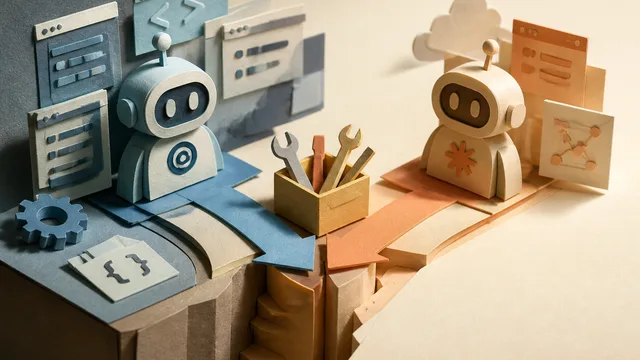
GPT-5.6 Sol vs Claude Fable: What Actually Matters
GPT-5.6 Sol is faster and more autonomous than Claude Fable — but the real story isn't which model wins. It's how you divide the work between them.

Hugging Face ML Intern Automates AI Development
Hugging Face's ml-intern is an open-source agent that automates the full ML research loop. Here's what it does, what it can't, and what it signals.