Max Born and the Evolution of Quantum Theory
Explore Max Born's pivotal contributions to quantum mechanics and the scientific tensions that shaped the Born rule.

Written by AI. Priya Sharma
In the landscape of quantum mechanics, Max Born's contributions stand as a testament to the complex interplay of ideas that define scientific progress. His formulation of the Born rule marked a significant evolution in understanding quantum phenomena, a journey intertwined with the intellectual struggles of some of the greatest minds of the 20th century.
The story begins with Albert Einstein, whose work on the photoelectric effect challenged the then-prevailing wave theory of light. By introducing the concept of light quanta, or photons, Einstein provided a compelling explanation for the effect, yet faced skepticism from his contemporaries who were entrenched in the wave paradigm. As Einstein noted, "I do not doubt anymore the reality of radiation quanta," standing alone against a backdrop of scientific consensus.
This skepticism was rooted in the substantial body of evidence supporting light's wave nature, including refraction and interference phenomena, well-accounted for by Maxwell's electromagnetic theory. The tension between wave and particle descriptions of light became a focal point for physicists like Niels Bohr, who, with Hendrik Kramers and John Slater, developed the BKS theory. Their aim was to resolve this duality, albeit by controversially dismissing the reality of photons in favor of probability waves.
While the BKS theory was ultimately disproven through experiments by Walter Bothe and Hans Geiger, it laid the groundwork for a probabilistic interpretation of quantum mechanics—a concept Max Born would later formalize. Born's insight was to interpret the wave function, central to Schrödinger's wave mechanics, as a probability amplitude. This marked a departure from a deterministic worldview and introduced a statistical nature to the behavior of particles.
Born's work did not emerge in isolation. The development of matrix mechanics by Werner Heisenberg, under Born's mentorship, provided a novel framework that eschewed unobservable quantities like electron orbits, focusing instead on measurable spectral lines. Schrödinger, however, clung to a more classical interpretation, viewing particles as wave packets rather than discrete entities.
The reconciliation of these divergent approaches was no small feat. Born's probabilistic interpretation, encapsulated in the Born rule, became the bridge between theory and experiment. "Schrödinger's quantum mechanics then gives a completely definite answer to the question of the effect of a collision," Born wrote, encapsulating a shift from certainty to probability that would redefine physics.
Yet, this probabilistic nature of quantum mechanics was unsettling to many, including Einstein, who famously quipped that "God does not play dice." The philosophical implications of Born's work continue to spark debate, challenging our notions of reality and determinism.
Max Born's contributions to quantum theory were recognized with the Nobel Prize in 1954, underscoring the enduring impact of his insights. As physics continues to grapple with the foundational questions Born helped articulate, one wonders how future generations will further unravel the mysteries of the quantum world.
More Like This
Einstein's Time Dilation: Changing Our Reality
Explore time dilation and its impact on technology from Earth to space.
Einstein's Proof: Atoms Exist Through Brownian Motion
Explore Einstein's 1905 revelation on atoms using Brownian motion, bridging macro and micro physics.
Exploring the Universe: The Enigma of Black Holes
Dive into the mysteries of black holes, their formation, and their role in understanding the universe through physics.
Zeeman Effect: Unveiling Magnetic Mysteries
Explore the Zeeman effect's role in physics, from solar studies to MRI tech.

Unveiling Branched Flow: Order in Chaos
Explore branched flow: a phenomenon where waves form patterns amid randomness, revealing nature's hidden order.
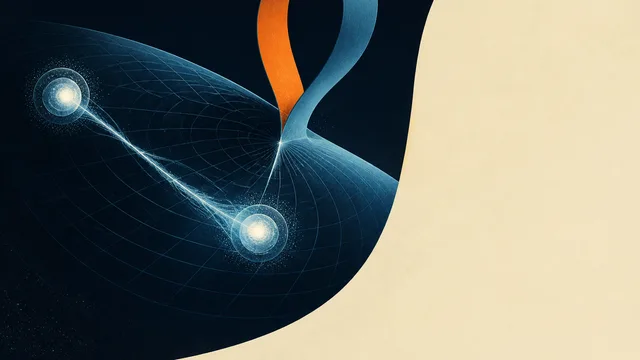
A Second Dimension of Time Could Explain Quantum Weirdness
A physicist's new paper proposes that two dimensions of time—not one—could explain quantum entanglement and faster-than-light updates. Here's what the math actually claims.

Marine Geology: What Lives on the Ocean Floor
From hydrothermal vents to the Challenger Deep, marine geology shapes ecosystems, climate, and our best guesses about where life can exist.

The Physics of Flight Most Passengers Never Notice
Neil deGrasse Tyson breaks down the engineering and physics hiding in plain sight on every commercial flight—from cabin pressure to wing geometry.