How AI Is Quietly Dissolving Expert Knowledge Forever
Specialized knowledge that took decades to build is being compressed into AI skills. Once it's in the model, you can't pull it back out.

Written by AI. Yuki Okonkwo
There's this thing happening that nobody's quite saying out loud: the protective moat around expert knowledge is evaporating.
Daniel Miessler calls it "The Great Transition"—a term that sounds grand but actually captures something specific and unsettling. In an 83-minute breakdown, he maps out how multiple shifts in AI and software are converging on the same endpoint, and once you see the pattern, every AI announcement starts making uncomfortable sense.
The core thesis? We're watching knowledge, interfaces, and entire business models liquify in real-time. And it's happening faster than the systems built around expertise can adapt.
The Diffusion Problem
Here's the uncomfortable part: specialized knowledge used to be safe because it lived in people's heads. Even if you wrote books, gave talks, published papers—you still retained maybe 90% of what you actually knew. That tacit knowledge, built over decades of practice, was un-copyable.
Then came LLMs. Then came Anthropic's Skills—markdown files that can encapsulate chunks of expert knowledge. Then came the realization that you can prompt an AI to "find everything Dr. Huberman has ever said about morning routines and turn it into a skill."
"This is one prompt," Miessler emphasizes. "Find everything Huberman has said about morning routines from every podcast he's ever done, every blog he's ever done, whatever he's ever put out, every article, every interview, and put that into a skill."
The gap between what a 40-year specialist knows and what everyone else knows? It's shrinking. Not because people are getting smarter, but because the knowledge is being pulled out of private domains and diffused into public models.
Miessler uses a metaphor that's blunt but accurate: "It's like peeing in the pool. You can't pull it out. Can't pull it out. It's just going to be in there."
The Chinese labs, he notes, seem to have figured this out as a strategy. DeepSeek and others are absorbing techniques from billion-dollar Western labs and releasing them into open-source models within months. Whether through distillation or other methods, the knowledge gradient flattens quickly.
The API Becomes the Product
Miessler predicted this in 2016 (yes, 2016) in what he calls his "stupid little book": businesses will become APIs. Not "have APIs." Become APIs.
The shift is already visible. Excalidraw released a feature where you describe a diagram and it generates it in your aesthetic. Cool! Except Miessler's reaction was: "There's no way I'm going to use it. Can you make this available as an MCP?"
His point: "If I have to open an app, I have already lost. It means my tooling is horribly broken. My AI should be doing all of this for me."
This isn't about preference—it's about infrastructure. When there are 27,000 background-removal tools (his number), consumers won't evaluate them. Their AI agents will. Services will be rated like movies on Rotten Tomatoes, and your agent will pick the highest-rated one based on your preferences. Done.
The product is the API. The interface? That's between you and your agent now.
SEO for Machines
This kills several things at once. Traditional interfaces become vestigial. Marketing websites designed to persuade humans become... less relevant. SEO—the art of being attractive to users—pivots to being attractive to users' AIs.
"When I say, 'Hey, I need a new mattress,' I'm not saying that to Google," Miessler explains. "I am saying that to my agent. My DA knows my sleeping habits, knows if I like a firm mattress or a soft one."
The agent does the search. The agent evaluates options. The agent presents the recommendation. Marketing needs to convince the AI, not you. Which raises questions nobody's fully grappled with: What does AI-to-AI persuasion look like? How do you game that system? (Spoiler: people will absolutely try.)
Enterprise as Graph
The consumer side is moving fast. The enterprise side is slower but potentially more fundamental.
Miessler's vision: companies will become "graphs of operations." Every task, every SOP (standard operating procedure), every decision point—mapped. Not in someone's head or in scattered documentation, but in an actual executable graph that AI can see and optimize.
Right now, if you're a CEO, you can't pull up a map of every task happening in your company. There are people doing fraud detection on insurance claims, people managing logistics, people writing code—but there's no unified graph showing how it all connects.
AI will build that graph. It has to, in order to automate effectively. And once the graph exists, the question becomes: which nodes need humans?
He's clear that this is just starting. It's much slower than consumer AI adoption. Companies are still figuring out what to do with AI. But the direction is set.
The Bespoke Software Future
All of this converges on a single idea: software becomes custom. Not personalized in the "here are your recommended products" sense, but actually bespoke—generated on-demand for your specific needs by your AI.
You won't download apps. Your agent will synthesize functionality from APIs. You won't browse interfaces. Your agent will present what you need when you need it, styled how you prefer.
Miessler laid this out in 2016 as "everyone gets a digital assistant." Eight years later, we're watching it materialize. The timeline is compressed now. Skills, MCPs (Model Context Protocol), agent frameworks—the infrastructure is being built in real-time.
What Gets Lost
Here's the part Miessler doesn't dwell on but hovers around the edges: what happens to the experts whose knowledge gets diffused?
If you spent 30 years becoming the person who just knows things—the consultant who walks into a room and sees patterns others miss—and that knowledge is now accessible to anyone with the right prompt... what's your value proposition?
Miessler is clear about the impact: "The delta between what they know and no one else knows is getting smaller, and that is massively, massively impactful for humanity in general."
Massively impactful—but in which direction? Democratization of knowledge sounds positive. But it's also a category of labor becoming obsolete. Not manual labor this time—knowledge labor. The kind we told people was safe.
The video doesn't answer this. It maps the terrain and trusts you to see where the rivers are flowing. Every new AI announcement—every new skill release, every API integration, every agent framework—is a data point confirming the pattern.
You can nod and say "yeah, that fits." Or you can ask what happens when the pool is completely saturated and there's nothing left to protect what you know.
More Like This
Does AI Understand Things, or Just Predict Words?
The "AI just predicts tokens" argument is technically true—but is it the whole story? A murder mystery with fake physics might hold the answer.
Claude Code & Remotion: A Game-Changer for Video
Explore how Claude Code and Remotion transform video creation with AI-driven motion graphics. Dive into the future of content creation.
Ralph Wigum Plugin: Persistence for Claude Code
Explore Ralph Wigum, a plugin for Claude Code that ensures AI task persistence and self-correction.
When AI CEOs Won't Hold Hands: Inside the India Summit
Sam Altman and Dario Amodei's awkward stage moment captured the tensions beneath the AI Impact Summit's grand promises of global AI access.
Claude Code Just Got a Remote—And It's Taking Aim at OpenClaw
Anthropic's new Remote Control feature lets developers manage Claude Code sessions from their phones with one command. Here's what it means for OpenClaw.
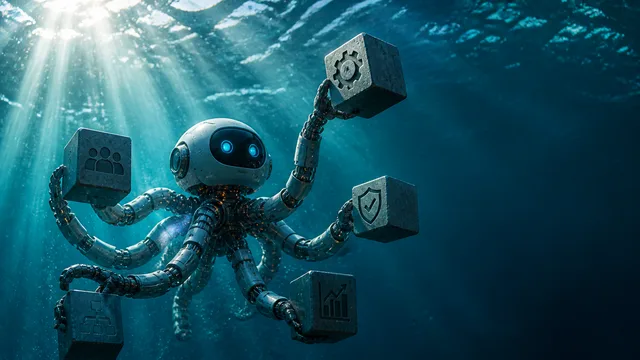
AI Agents in Production: What Actually Works
IBM's Shailaja Patel-Pranav breaks down why AI agents fail in production—and the coordination patterns that make them actually reliable in enterprise workflows.

How Optimization Powers Modern AI and Engineering
From training ChatGPT to imaging black holes, optimization is the hidden engine behind modern AI and engineering. Steve Brunton's lecture explains how.
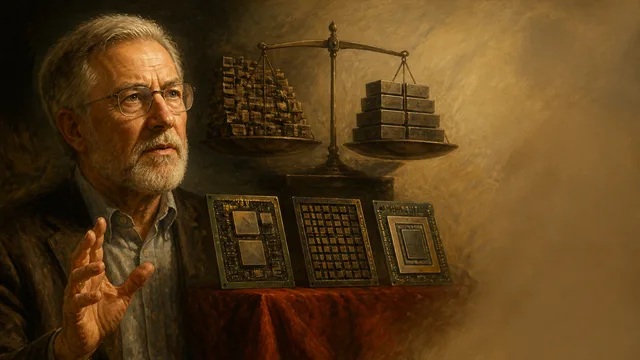
David Patterson on CPUs, GPUs, TPUs, and 50 Years in Computing
Turing Award winner David Patterson breaks down RISC vs. CISC, the GPU-to-TPU shift, Moore's Law's real status, and what 50 years in computing actually taught him.